Showing posts with label freedom. Show all posts

Thursday, June 4, 2020

Faith Like Jazz

I love jazz music. One of my favorite albums (of any kind of music) is Miles Davis' "Kind of Blue."

I will also be quick to say that I don't totally get jazz. I know there are a lot of interesting things going on in jazz that trained musicians can pick up on and dissect. Some jazz gets really experimental and ... unique. That's not the jazz I love.

Instead, I love the Miles David/John Coltrane style of jazz. The kind of jazz you imagine in a smoky bar with a three- or four-piece group providing the background to conversations between people in fedoras and boas. (Which is where I've heard some of the best jazz in my life.)

What I love about jazz is the improvisation. I love listening to the way the band will take a riff and play around with it for several measures, trying different things each time. Or the way one of the instruments will go on a solo, pouring out sounds that are more like emotions than notes while the others maintain a regular rhythm to hold her/him on a path. In jazz there is both creativity and freedom, and there is a kind of restraint because all the parts are working together toward a common goal.

I love jazz.

I also love Jesus. And I think following Jesus should be a lot like jazz.

When I was growing up, a lot of Christian teaching made me think there was a specific way to follow Jesus. There was a set of rules to follow and a certain way to act and dress and if you followed all of them, you were Christian. If you didn't, well, thanks for playing.

In my music analogy, it would be like saying, "To follow Jesus, you need to play the piano and play 'Moonlight Sonata' perfectly."

But I think that's too narrow a view. Especially today. Life rarely follows a neat, clear path where every action has a predictable reaction. And every person in the church doesn't have the same gifts or passions or reasons for being in church. Instead, I think living a life of faith is like playing jazz music.

You have a group (church or fellow Christians) who have different instruments (talents) and you're all working together to make a beautiful piece of music (bring God's life to earth). But you're also improvising, repeating common themes (love, forgiveness, mercy) in different ways to create new sounds and ideas. The members are doing their own thing, but working together, being creative and free, but following certain patterns that are familiar to all participants.

This is much more like faith as I've experienced it than "Here's a piece of music. Memorize it." It's also what the church needs to be today.

We are in a time when technology and globalism are changing things constantly. We are in a time where we live with many differences in generations, ethnicity, gender identity, and more, even within one neighborhood.

In order to adapt, to love everyone, we need to improvise. We need to play around with familiar riffs in new ways. We need to work with the other members of the band to avoid chaos. We need to have a sense of playfulness and imagination, following the path of grace and love, but creating something new on the way.

This is why the church has been so different over the ages in a variety of cultures and eras, but still grounded in the same truths.

Faith is like jazz. Follow along.

From the Gray,
Pastor Ari

"Oh my life will be here waiting for you, my love, to find your way back home to me." -Sophie Milman, "Back Home to Me"

Friday, November 13, 2015

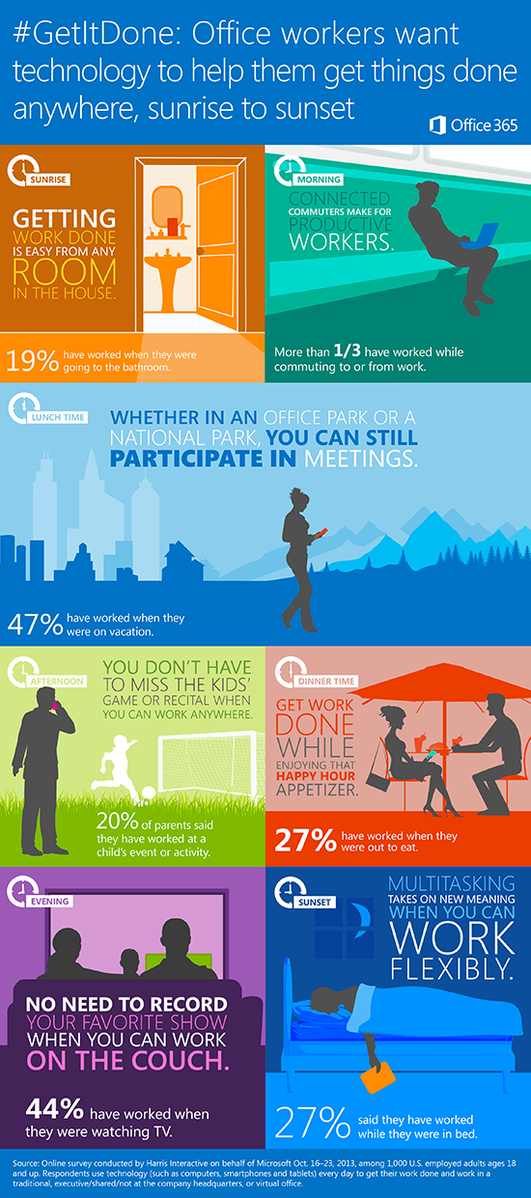
The Worst Ad I've Seen All Year

This advertisement is disturbing.

If you can't read the smaller version I've added to this blog, you can see the original here. In brief, Microsoft is promoting their new line of Office products by suggesting workers are wasting a lot of potential work time by being away from the office. Microsoft can enable them to work anywhere! Bathroom? Work space! Vacation? Meeting time! On a date? Email!

Just imagine being able to work every waking moment of the day, every day of the year...

Of course the sad truth is that for many people, life already feels like this. We are one of the hardest working nations on earth, but we're also one of the most stressed out, exhausted, and suffer from a variety of health problems that are probably related to the first two. We don't even take all of our vacation.

There are a variety of reasons for us to reexamine the mindset that thinks the life this Microsoft ad promotes is a good idea. But combatting overworking isn't just an economic or health issue. It's a faith issue.

I say this is a faith issue for several reasons. I think for decades or centuries, we in America came to make industriousness synonymous with being a good Christian. There are lots of reasons for this, but I put a lot of the blame at the feet of our Puritan founders. (Long story short: Puritans came to see economic success and hard work as evidence of a healthy inner-faith and therefore worked hard to "prove" their salvation.) As we've largely combined Christian and American values, for better or worse, we've come to largely assume that working hard at our jobs is both the American and Christian thing to do.

But as Christians, we are called to do more than our jobs. Martin Luther insisted that all Christians have vocations ("vocation" literally means "calling") given to them by God. And, yes, the one that pays the bills is part of it, but Luther was also insistent that God calls us to be parents and friends and siblings and spouses and many others that may not be jobs, but are key to sharing God's love in society, practicing faith, and maintaining our own faith. Ignoring our kid's soccer game or doing work while watching a movie as a family is neglecting all the other vocations God has given us to give and receive love in our lives.

God calls us to invest in relationships. Because we have been given a restored relationship to God, we are drawn to restore relationships with others. Work has its place in our society and there will certainly be times we do need to work long hours, but it isn't all that we are. We earn a living at work; God gives us life to be shared.

From the Gray,
Pastor Ari


“Today is all you’ll ever have. Don’t close your eyes.” -Switchfoot, “This is Your Life”


Friday, January 30, 2015

Vegetarians for Jesus!

(Author's note: As often happens, this coming Sunday has more than one great text assigned for reading in worship. Since I can't preach on all of them, what follows is something close to what I would preach if I were using the text from 1 Corinthians.)

At first glance, chapter 8 of Paul's first letter to the Corinthians sounds a little bit like a primer on pagan picnic etiquette. He talks a lot about food, idols, and "weak believers." Should you eat this food? How much? What kind? The whole passage can sound strange to modern, Western ears because Paul is addressing an ancient controversy. At the heart of his words, though, Paul offers pastoral and practical advice for a church working to live their faith daily. (That's actually most of Paul's intent in 1 Corinthians. One of the reasons I love it so much.)

The controversy at the heart of this passage is meat that has been offered to idols. Corinth was a religiously diverse city and most of the religions sacrificed animals in their ceremonies. Leftover meat from these ceremonies was usually sold in the public markets. The question Christians had was, "Are we offending God if we eat food that was first offered to idols?" Since many of the local church had converted from these religions, the question could be even more personal: "Can I eat dinner with my pagan relatives/friends if they serve meat?" (This same issue is behind Paul's comments on meat and veggies in Romans 14.)

Paul's answer is simple. "We know that 'no idol ... really exists'" (v. 4). Since there are no other gods, the meat was sacrificed to nothing and it doesn't have any spiritual or magical properties. It's just meat. And eating it doesn't harm us or God. Christians are free to eat whatever we want. 

But there's a "but."

Yes, we know this is just meat, but others may not. If someone sees you eating idol meat, will they think, "She must worship Jesus and Apollo. Maybe they're the same thing" or "I thought these Christians were different, but maybe not." Out of love for others, we must think about how our actions affect them. If eating meat keeps someone from knowing Jesus, then we should be vegetarians. Yes, we are free, Paul says, but what we do with that freedom matters. 

And it's on this point that this passage about an ancient controversy is still profoundly relevant for today. In the 21st century, individual rights are more common, expected, and celebrated than ever before. For those of us who are Christian and American, we have the freedom to live, think, say, and do pretty much whatever we want, both civically and spiritually.  But what we do with that freedom matters.

As a secular example, just because our freedom of speech means we can say or write something cruel or unfriendly, does that mean we should to prove a point? How does being mean in the name of freedom forward our democracy? In the same way, how does using our spiritual freedom to flaunt God’s generosity forward the Kingdom? Using Christian freedom to serve my own personal desires is just another form of what Dietrich Bonhoeffer called "cheap grace."

After all, to act and live as if our freedom trumps any consequences is the same as saying, “Nothing we do matters. My actions make no difference.” And I’ve never known anyone who has told me they want their life to be meaningless or they want to leave this world having not done anything that matters. 

Part of what Paul is teaching is that the very thing that sets us free from needing to prove ourselves is also what makes our actions meaningful because we are part of a community. God's love sets us free, but our efforts to imitate that love bind us to each other, because love cannot exist in a vacuum. 

Years ago I heard a story of an American entertainer (Will Rogers, maybe?) who was at a social event and reaching for a beer when he saw some kids and thought, "They look up to me. What will my drinking mean to them?" He put the beer down, the story goes, and never drank publicly again. That story and Paul's advice to Corinth are often forefront in my mind as a pastor because I realize how I speak, act, and live affects how people see me, my faith, and my profession... and, in part, how they see God.

Like the Corinthian church of old, we are free to eat/say/do what we want, but we are also called to act with love in all we do. That can be a narrow or even hazy line to walk sometimes and I don't always know what is best in every situation, but as Paul points out, sometimes having the right answer isn't as important as having love in the attempt.

From the Gray,
Pastor Ari

“Give us days to be filled with small rebellions; senseless, brutal acts of kindness from us all.” -Jars of Clay, “Small Rebellions”