Showing posts with label baptism. Show all posts

Friday, November 16, 2018

The Third Sacrament


(Note: This was first written for my church's winter newsletter in December 2018)

In the Lutheran church, we acknowledge two sacraments: communion and baptism. Martin Luther felt there needed to be some Biblical basis for defining a sacrament and cut back on the total of Roman Catholic sacraments. The definition he settled on had three parts: a sacrament had to a) be commanded by Jesus, b) have a physical sign, and c) have a promise of grace attached to it. 

A few practices and traditions that are important to us fail to be a full sacrament because they lack one of these three. Confession and forgiveness for instance is commanded by Jesus and has a promise of grace, but not a physical sign. Foot washing is commanded and has a physical sign, but not a promise of grace. 

Over the years of being a pastor, I’ve come to believe there is a third sacrament that should be acknowledged and celebrated in church. I believe it is a sacrament even though as far as I know it isn’t acknowledged as one in any denomination. I believe the third sacrament is us, the Church itself, the Body of Christ. 

I could spend more time explaining my thinking, but in short, I believe Jesus commands us to be together (John 14:20-21), promises us grace when we come together (Matthew 18:20), and there is a physical sign — each other. 

I share this idea with you because we are heading again towards the seasons of Advent and Christmas. In these seasons, we share presents and carols and egg nog, but at their heart is an idea closely tied to this third sacrament: incarnation or God made flesh. In this time of year, we remember the arrival of God’s son, Jesus, in human form. In taking on flesh, he became a blessing to those around him, a source of light in a time of darkness, and a sign of God’s love to those in need. 

In another time that feels full of darkness, there is comfort in this story. Our politics are a mess, natural disasters and mass shootings seem to happen weekly, wars continue to rage around the world and even allies don’t seem as trustworthy as they once did. That God took flesh to offer hope and life in a similar time is a sign of grace, but we need also remember it is not in the past. 

Jesus didn’t just come in the flesh; he comes in the flesh. And just as he did in Palestine centuries ago, he still comes to be a blessing to those around him, a source of light in a time of darkness, and a sign of God’s love to those in need. Because of the work the Holy Spirit continues to do in us, I believe we are a sacrament, a source of grace and life to each other and the world around us. 

May we know the presence of Christ this holiday season. May we see Christ take flesh in those around us and may we be open to how God takes flesh in us. May we be surprised (have “epiphanies”) about the ways God is working around us. And may God use us to be a blessing to the world around us. 

From the Gray,
Pastor Ari


"When everyone you thought you knew deserts your fight, I'll go with you." -twenty one pilots, "My Blood"

Saturday, March 25, 2017

Shame, Confession, and True Identity

This past Sunday, I was privileged to have a member of my church's preaching team provide the sermon. I love getting to hear others preach because it helps me hear other facets of the text and fresh perspectives that help me shape my future sermons.

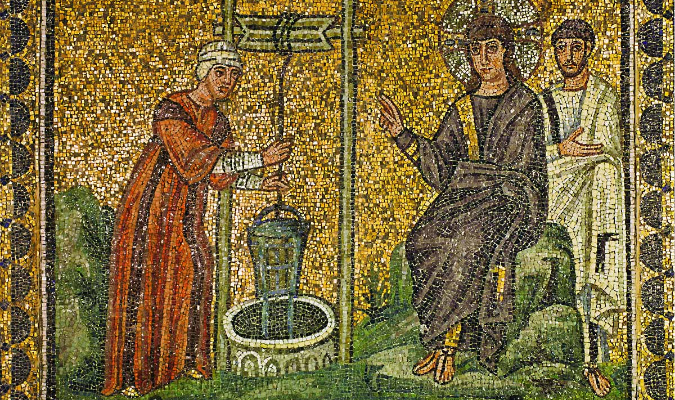
In her sermon (which can be heard here until late April), Carla had a line that cast a fresh light on one of my favorite Bible passages, the woman at the well in John 4. Noting that the woman is gathering water at an unusual time of day, Carla suggested, as most commentators do, that she had been shunned by her neighbors who come in the morning. But then she asked, "Or is it her own self-doubt?"


I'd never thought of that. Shame is a powerful force for tearing us down, but it isn't always imposed from someone else. It can come from ourselves, too. Was this woman shunned by her community or did she exile herself? What little we know of her ("You've had five husbands" v. 18) means she's been widowed or abandoned five times (women didn't have legal standing to seek divorce then). She's known a lot of heartache. I'd never considered that her heartache could be causing her to isolate herself in shame. Perhaps she tells herself, "You're unlovable. They don't want to be near you. You're such a failure."


We all carry such voices around with us; little shame demons that point to our failures (actual or perceived) and our flaws (real or not). They can be rooted in minor incidents from our childhood that scarred us deeply or from repeated behaviors that we can't seem to stop doing. They can be from things we've done, things done to us, or things we've failed to do. They show up in phrases we repeat in our heads:
  • "I'll never really belong at work/in my family/with my friends/at church because I'm imperfect/stupid/different/flawed." 
  • "I'm just not cool/interesting/funny/attractive and someone's going to figure that out."
  • "If I don't keep my life balanced perfectly, I'm going to disappoint people and they'll stop liking me."
  • "If people really knew what I was like..."
Like the woman at the well, shame can lead us to avoid people, hide part or all of ourselves, or just believe that we're not that good or worthwhile.

All of this is why I love that our order of worship in the Lutheran church always begins with confession and forgiveness. Some people look at confession as a negative thing that creates shame by forcing us to think about how bad we are, but I don't.

For me, confession is confronting the shame that I carry with me and the voices that point out my flaws and then being reminded that they don't define me; that's not who I really am.

Because when I stand at the baptismal font each week during confession and splash in the "living water" that Jesus promised the woman at the well, I'm reminded that I'm a child of God, claimed by God's promise of eternal life. My shame and faults that make me feel worthless don't get the last word because I'm someone worth dying for according to Jesus.

My true identity is found in my baptism. When shame leads me to hide away, to avoid the crowds and come to the well in the middle of the day, I can remember that God's identity for me gives me a second chance. I don't need to fear living life fully or being vulnerable because the things I may feel shamed about (by others or myself) don't have to define me. God can reconcile and redeem the points of shame into empathy, wisdom, and compassion for others.

We don't need to live in shame or hide from the crowds. We don't need to listen to the negative voices tearing us down inside. The voice of Jesus says we're forgiven, loved, and adopted as children of God. That's our true identity.

From the Gray,
Pastor Ari

"Here in my head full of shame, you pick me up and say I look like You." -Jars of Clay, "Sing"

Monday, February 24, 2014

Dusting Off Our Baptism

(Note: This post first appeared in my church's newsletter.)

The congregation I grew up in had a gorgeous baptismal font. The bowl was cobalt-blue glass and the stand was made of artistic, looping brushed steel. It was evocative and symbolic…and it spent most of the time stashed in a corner or in a storage closet. It was only ever brought out when it was needed for a baptism and then it was put somewhere out of the way.

And this always bugged me. For years it bothered me just because I thought it was beautiful and deserved to be seen, but as I studied theology and became a pastor, it bothered me because it tells the wrong story of baptism. 

Baptism is an act of grace and salvation from God. In baptism, our selfish, sinful self is drowned out of us and we are marked with the cross of Christ and bound to God’s promise of eternal life, a promise that we don’t stick in a baby album, but one we return to constantly. When Martin Luther wrote about baptism, he wrote about daily returning to the waters and being reminded of that promise. He wrote that whenever we despair or believe we are unloved, we should chase away evil by crying out, “But I am baptized!” 

Like that font, baptism is beautiful and evocative and special and it deserves to be seen every day; it is not something we consider “done” and then put away in the corner to gather dust. The promises of baptism are over, under, and around everything we do in our lives, but I think we are often taught that they, like the font, only come out at special times. Trying to bridge that gap, to make us daily aware of God’s presence in our lives, even in mundane, so-called “secular” tasks, is one of the driving thoughts behind my preaching, ministry, and theology.

So then a pastor friend of mine, with whom I often discuss such topics, sent me a link to a video with the question, “What about doing this with our churches?” The video was of a researcher named Shawn Achor who was describing a process for increasing happiness by developing five daily practices. By tweaking the wording of just two of the five, we saw a way to use it to increase attentiveness to God’s presence and action in the world around us. This became what we at Martin Luther Church are calling “Cross+Training.” 

During Lent, I am inviting people to join me in Cross+Training by daily journaling or sharing 3 gratitudes, sharing a place I saw God active in the world around me, praying for 5 minutes, doing a random act of kindness, and doing exercise or a physical activity for 30 minutes. To be clear, doing this won’t make God love me more or guarantee my salvation, which has been promised to me in baptism, but I hope it will make me and those who join me more aware of those baptismal promises that attend me daily. Hopefully it brings my baptism splashing out into the middle of my activities and less likely to be something gathering dust in the corner until I "need" it. 

“Lead me to the truth and I will follow you with my whole life.” -Mumford and Sons, “White Blank Page”

Thursday, January 16, 2014

God's New Year Resolution

Every year, two things happen in January.

First of all, many people make New Year resolutions where they promise to make themselves better in some way this year.  "I will exercise more." "I will eat healthier." "I will laugh more... spend more time with my kids... quit smoking..." And so on. I generally do not make resolutions (the list of needed improvements is longer than can be tackled in one year), but I do usually at least think about what I'd like to see improved.

The second thing that happens every January, though largely ignored by everyone except church nerds like me, is Baptism of Our Lord Sunday. Baptism of Our Lord Sunday is always the Sunday after Epiphany on January 6 and is meant to remember the baptism of Jesus by John in the Jordan. It can also be a day to remember and celebrate the baptisms of all believers and I usually like to have a celebration of baptism be part of worship on that day.

What has never occurred to me until this year is how these two things can be linked. Martin Luther talked about baptism as a daily renewal, a constant source of God working in us to make us more holy. Daily we are justified (meaning "put in line with God") by our baptism. To Luther, baptism isn't a one time event, but a way of living, a daily practice and reminder of God's work in us to make us who we are meant to be.

In other words, baptism is a daily New Year resolution. But it's not a resolution we make on our own; it's one that God has made to us and God partners with us to shape us into the best version of ourselves. It's also one that doesn't get abandoned after a month or two because God's promise to us doesn't disappear.

And here's the even deeper connection between these two things: most all the things we resolve to do for New Year's can be ways of honoring and serving God. Taking care of our bodies and making them healthy is caring for the dwelling place of God because "you are God's temple and God's spirit dwells in you" (1 Cor. 3:16). Have a healthy body also makes us better able to help and work for others. Spending more time with family and friends builds the loving relationships God calls for us to have. Getting our finances in order removes a distraction (and an idol?) and can free us to be more generous with our resources.

Being baptized into Christ means that God is constantly resolving to make us more healthy, whole people, both spiritually and physically, internally and externally. We are called to live baptized, to constantly be renewed and improved by the Spirit, not just in the New Year, but every year, every week, every day.


“I don’t want to leave unchanged.” -Shaun Groves, “After the Music Fades”