Showing posts with label preaching. Show all posts

Tuesday, September 13, 2022

Learn the Story: How the Old and New Testament Fit Together

Illustration by Aase Mattson
While I was growing up in the church, I got the impression that the Old Testament, which makes up the first three quarters of the Bible was... well, old. As Christians, we could learn some important things from the Old Testament (or the Hebrew Scriptures) but it was mostly background information. The Bible that really mattered was the New Testament, the Greek Scriptures, because they were about Jesus.

As I grew and studied scripture though, I came to a very different conclusion of what Christianity teaches. Thanks to some good mentors and authors like Philip Yancey and Daniel Erlander, I realized that the New Testament doesn't replace the Old Testament, it continues and completes it. 

One of the best examples of this is in Luke 24, where the resurrected Jesus twice explains to his disciples how his ministry, death, and resurrection is a fulfillment of the Hebrew Scriptures: "everything written about me in the law of Moses, the prophets, and the psalms must be fulfilled" (v. 44). (See also: v. 27) Jesus is the culmination of everything that has been taught and done through the history of God's people, not the rejection of it. In fact, if you aren't familiar with the Hebrew Scriptures, you miss a lot of the symbolism and meaning behind what Jesus does.

Unfortunately, I still hear from people that they believe (or have been told) that the Hebrew Scriptures are... old. 

This past week, I started a special sermon series at my church I'm calling "Rooted: Learn the Story."  I'm teaching from ten major stories of the Old Testament in order to show how they are part of one continuous story and how that story points us to Jesus. If that's the kind of thing that interests you, please check out the sermons as they are posted on our YouTube page. The first one, "Made in God's Image," can be seen here. In it, I make two central points: 1) to be created in God's image means we are created to reflect God's character and nature to the world and 2) when we do, creation is good, as God intended it to be. 

I hope someone may find this helpful.

From the Gray,

Pastor Ari


"Gonna need a little water from another time." -John McCutcheon, "Water From Another Time"


Rooted: Learn the Story Sermons

  • September 11:
    • Made In God’s Image -- Genesis 1:24-2:3
  • September 18: 
    • Rejecting God’s Image -- Genesis 3:1-13, 19-23
  • September 25: 
    • Abraham, Sarah, and the Forever Promise -- Genesis 12:1-8
  • October 2: 
    • Blessed and Limping (Jacob) -- Genesis 32:9-12, 22-31
  • October 9: 
    • God the Liberator (Exodus from Egypt) -- Exodus 3:1-14
  • October 16: 
    • Becoming God’s People (10 Commandments & The Wilderness) -- Exodus 19:1-8
  • October 23: 
    • What is a Messiah? (Saul, David, and the Kings) -- 1 Samuel 10:17-25
  • October 30: 
    • When Everything Falls Apart (The Exile to Babylon) -- Jeremiah 29:1, 4-14
  • November 6: 
    • How to Speak to God (The Psalms) -- Psalm 13 and Psalm 23
  • November 13: 
    • Don’t You Remember? (The Prophets) -- Micah 6:1-8

Thursday, February 20, 2020

5 Old Testament Stories Every Christian Should Know

I recently ended a sermon series at my church that I called, "5 Old Testament Stories Every Christian Should Know." (You can listen to some of them here until March.) It was an idea that grew out of a lot of Bible studies, pastoral conversations, and personal study from the past few years. I found that I was making more connections to the Old Testament, but many people didn't have a good understanding of the stories or assumed they were unimportant because they weren't in the New Testament.

(To be clear, I don't fault anyone for not knowing the Old Testament well. Many Christians, and especially ELCA Lutherans, have either deemphasized it or just focused on the violent portions.)

The five stories that I find myself using the most when I preach or teach are Creation, Abraham and Sarah, the Exodus, King David, and the Exile. Having completed the preaching series, I thought I should summarize it here for those who couldn't attend all or any of it and to have brief summary for future reference. As I mentioned in my sermons, I could not to full justice to these stories in a 15-minute sermon, so my focus was on three questions: What happened? How does it relate to Jesus and the New Testament? and Why does it matter to us today?

I was also challenged by a member of my congregation to sum up every sermon in one word to make it easy to remember. Having hopefully met his challenge, I will use those here as well.

Creation
Word: Good
When the story of creation gets discussed, it often centers around the creation-evolution debate. I think that's a red herring. The more important part of the story is that God calls this world "good," or "tōv" in Hebrew. This world is meant as a blessing for us and for all life in it. It isn't inherently evil or corrupted (which goes against some Christian denominations). To the degree it is corrupted, it's because of us. Humans reject God's good order and plan and instead shape the world in our image. Out of alignment with God, things often go badly. But as we see in this story, God creates order out of chaos. Jesus puts us back in alignment with God and orders our chaos (or sin) to become a blessing again. And it is good.

Abraham and Sarah
Word: Promise
Abraham and Sarah are given an unbelievable promise from God: follow me and I will give you a great family and bless all people through you. They do follow God, but they don't always do it well. In fact, they make some big mistakes along the way. However, God never breaks the promise. Even when the following generations also prove to be deeply and tragically human, God remains faithful and continues to renew the promise. Abraham becomes the spiritual ancestor of three world religions --Judaism, Christianity, and Islam-- and in Jesus, God fulfills the promise to bless all people, offering life to everyone, not just Abraham's blood relatives. When God makes a promise, God keeps a promise.

The Exodus
Word: Liberation
When God calls Moses to become a liberator, God says, "I know their sufferings, and I have come down to deliver them" (Exodus 4:7-8). That God sides with the Israelites, who are not powerful or important, but are oppressed and enslaved, gives us an important insight into God's character. God is keeping the promise to Abraham, but also creating a precedent of caring for the weak and freeing those who are oppressed. This God of compassion repeats this pattern throughout the Bible, especially in the person of Jesus, who saves us from the oppression of sin, drowns our spiritual enemies in baptism, and brings us into a new life where we can be God's people again. Whenever we're trapped, God works to free us.

King David
Word: Messiah
The Sunday I was scheduled to preach on David, I had to stay home sick. (Boo.) Pastor Vivian Thomas-Breitfeld did a great job filling in and naming how we are called to be tabernacles to carry God into the world like the tent of God in David's age. She also lifted up how David was a flawed king and person, but repented and was loved by God. My intent for the sermon was to name David's flaws as a king, but also how his example creates a flawed idea for those in Jesus' day and our own. One of the titles David is given is "messiah," which is not a unique title to Jesus. It literally means "anointed" and referred to someone chosen by God to defeat the enemies of God's people, build a holy kingdom, and rule with justice. David does this and becomes the example people expect from a messiah, but Jesus does it in a very different way. People expected the Messiah to defeat Rome, restore Jerusalem, and rule as king of Judea, and when Jesus refuses, he angers and confuses many. But Jesus does defeat the true enemies of God's people (sin and death), he builds a holy kingdom (a new reality built on resurrection and mercy for all people), and rules with justice as the true leader of this world. His time as messiah wasn't limited but is for all people in all time.

The Exile
Word: Homecoming
The Exile is a sad and complicated story, but it has its roots in the creation story: when humans reject God's good order, there are consequences. This time the consequence of ignoring injustice and putting their trust in wealth and military might means being crushed by Babylon and dragged off into mass imprisonment for 70 years. But God tells them before and during that time, "I will not forget you or abandon you." And after it is over, God brings them home where they belong. This mirrors the ministry of Jesus, who says we are exiled by our sin and separated from God as a consequence, but God will not forget or abandon us. Jesus comes to find us in exile and bring us home. There is no place we can go, physically or spiritually, that God will not come looking for us.

I love these stories because they aren't old stories, they are about a God who is still caring for people. They are our stories. And they are still being told.

From the Gray,
Pastor Ari


“Remember how it felt before. We still have a lot to live for.” -The Rescues, “We Are Not Alone”

Saturday, March 25, 2017

Shame, Confession, and True Identity

This past Sunday, I was privileged to have a member of my church's preaching team provide the sermon. I love getting to hear others preach because it helps me hear other facets of the text and fresh perspectives that help me shape my future sermons.

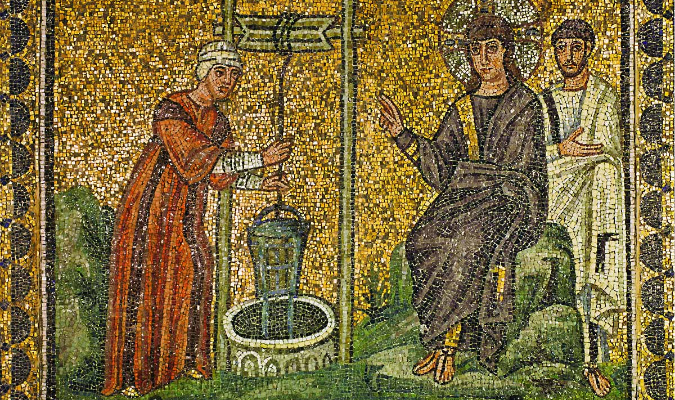
In her sermon (which can be heard here until late April), Carla had a line that cast a fresh light on one of my favorite Bible passages, the woman at the well in John 4. Noting that the woman is gathering water at an unusual time of day, Carla suggested, as most commentators do, that she had been shunned by her neighbors who come in the morning. But then she asked, "Or is it her own self-doubt?"


I'd never thought of that. Shame is a powerful force for tearing us down, but it isn't always imposed from someone else. It can come from ourselves, too. Was this woman shunned by her community or did she exile herself? What little we know of her ("You've had five husbands" v. 18) means she's been widowed or abandoned five times (women didn't have legal standing to seek divorce then). She's known a lot of heartache. I'd never considered that her heartache could be causing her to isolate herself in shame. Perhaps she tells herself, "You're unlovable. They don't want to be near you. You're such a failure."


We all carry such voices around with us; little shame demons that point to our failures (actual or perceived) and our flaws (real or not). They can be rooted in minor incidents from our childhood that scarred us deeply or from repeated behaviors that we can't seem to stop doing. They can be from things we've done, things done to us, or things we've failed to do. They show up in phrases we repeat in our heads:
  • "I'll never really belong at work/in my family/with my friends/at church because I'm imperfect/stupid/different/flawed." 
  • "I'm just not cool/interesting/funny/attractive and someone's going to figure that out."
  • "If I don't keep my life balanced perfectly, I'm going to disappoint people and they'll stop liking me."
  • "If people really knew what I was like..."
Like the woman at the well, shame can lead us to avoid people, hide part or all of ourselves, or just believe that we're not that good or worthwhile.

All of this is why I love that our order of worship in the Lutheran church always begins with confession and forgiveness. Some people look at confession as a negative thing that creates shame by forcing us to think about how bad we are, but I don't.

For me, confession is confronting the shame that I carry with me and the voices that point out my flaws and then being reminded that they don't define me; that's not who I really am.

Because when I stand at the baptismal font each week during confession and splash in the "living water" that Jesus promised the woman at the well, I'm reminded that I'm a child of God, claimed by God's promise of eternal life. My shame and faults that make me feel worthless don't get the last word because I'm someone worth dying for according to Jesus.

My true identity is found in my baptism. When shame leads me to hide away, to avoid the crowds and come to the well in the middle of the day, I can remember that God's identity for me gives me a second chance. I don't need to fear living life fully or being vulnerable because the things I may feel shamed about (by others or myself) don't have to define me. God can reconcile and redeem the points of shame into empathy, wisdom, and compassion for others.

We don't need to live in shame or hide from the crowds. We don't need to listen to the negative voices tearing us down inside. The voice of Jesus says we're forgiven, loved, and adopted as children of God. That's our true identity.

From the Gray,
Pastor Ari

"Here in my head full of shame, you pick me up and say I look like You." -Jars of Clay, "Sing"

Thursday, June 26, 2014

I Don't Like Genesis 22

I've been dreading this coming Sunday for over a month.

You see, this coming Sunday, the lectionary my church uses has appointed Genesis 22:1-14 as the Old Testament reading. And Genesis 22 is one of my least favorite parts of the Bible: the (near) sacrifice of Isaac.

This is the type of text that I usually preach on because there are elements to it that I just can't let pass without some kind of commentary. But the elements that make this passage so difficult also make it hard for me to shape into a decent sermon*. So after much thought I decided to wrestle with it here instead.

For those who are not familiar with the story, God chooses to "test" Abraham by asking him to sacrifice his only remaining son, Isaac, who was a miracle child and meant to start a great "nation" of people. (Abraham's semi-legitimate son, Ishmael, was already sent off in another troubling episode.) Abraham obeys and gets so far as placing his bound child on the altar and raising the knife to slay him when God steps in and stops him.

I'm bothered by the text because of the connections it holds with two problems that are sadly still relevant today: child abuse and violence in the name of God.  When we continue to see children abused and exploited and when suicide bombings, apartheid, and KKK lynchings backed by religious beliefs are current or in recent memory, it's troubling to read a story of God promoting this type of behavior and a person of God who is willing to do both -- and is commended for it.

There are many explanations of this text that seek to ease some of the tension in it:
  • God had invested a lot in Abraham in making him the father of promise and needed to know that he would be faithful regardless of the task.
  • Abraham's Schwarzenegger-esque words to his servant--"We'll be back"--suggest he expected that God wouldn't actually make him sacrifice Isaac and both would return.
  • God was using this episode to condemn child sacrifice (which was practiced by many of Israel's neighboring religions) and show Abraham how his God was different from other gods.
  • Isaac was likely a teenager and Abraham was over 100 years old and couldn't have over-powered Isaac. Therefore, Isaac wasn't a victim, but a willing participant. (In fact many early church leaders used this story as a foretelling of Christ, who also willingly carried the wood to be used for his execution up a hill expecting to lose his life.)
But none of those explanations answer the biggest problem I have with the story: Why did God feel the need to test Abraham? Was God feeling cranky? Was it morbid curiosity? Shouldn't God have already known whether Abraham was faithful? (Abraham had already left his family and home and moved hundreds of miles at God's request.) 

I want to believe that Abraham got the message wrong. I want to believe that between the time the events happened and they were written down, the detail of God testing Abraham was added by the scribes. But I believe that the hard parts of the Bible can't just be brushed off because they're hard or we don't like them. We have to deal with them.

But we don't have to deal with them in a vacuum.

One of the parts of Lutheranism that I love is how we read scripture and one of the key parts of how we do that is the premise that "scripture interprets scripture." Martin Luther, who was often arguing the meaning of scripture with his opponents, knew there were parts of the Bible that didn't seem to agree with each other and so insisted that difficult or confusing texts be read in the context of the whole Bible and especially in the context of the words of Jesus.

In that light, Genesis 22 is easier to swallow. Elsewhere, God clearly condemns child sacrifice (Lev. 18:21; Deut. 18:10), God speaks through Hosea to say "I desire mercy, not sacrifice," and Jesus says "Blessed are the peacemakers" and "Let the little children come to me, for the Kingdom of Heaven belongs to them." Regardless of whether God tested Abraham or why, I look for solace in the fact that in the end, God's true nature won out. God stayed the execution and kept Abraham from killing his son. That is some good news in an otherwise difficult text.

I still feel very uncomfortable with this text, but faith, like life, is rarely simple and God, if the Bible is any indication, is quite complicated. I sincerely pray often to know and understand God better, but Abraham knew God well and that didn't seem to make his life any simpler either. Just one more troubling thing to wrestle with.


“I’m not sure if anybody understands.” -Fun., “Some Nights”


*To me, a sermon is the Living Word of God encountering human reality and creating new life. That sounds kind of vague and fluffy, I'm sure, but what I mean by it is that a sermon is not the same as a lecture. A lecture passes along information; a sermon creates an encounter with God's law and gospel. Every attempt I made with Genesis 22 felt like a lecture.


Friday, March 21, 2014

You Suck and I Love You

I was recently challenged by someone after worship who felt that my sermon that day was saying "you're not good enough" which this person heard enough of elsewhere. "Everyone else in my life tells me I'm not good enough. I don't want to hear that from God."

Now, preaching is an inexact science given that I never know if what someone hears is what I meant to say and I always dread speaking incorrectly. (In other words, because human beings are involved in both sides of the process.) In this particular case, I was not trying to say "you're not good enough," but I think this person was correct in that I didn't make that point as well as I could have.

I had been trying to say that God helps us grow to be more loving and compassionate than we would be on our own. This is the core of a lot of Christian theology, but after listening to the critique of my words, I couldn't help but think that it's a difficult line to walk. God does love us even when we screw up, but I also believe that God calls for us to grow and "improve." Where is the line between being loved as we are and being challenged to become more?

One of the things I love about theology (especially Lutheran theology) is the concept of paradox, that two seemingly contradictory statements can both be true. (It's partly where the title of my blog comes from.) This particular paradox was obvious even to the early church leaders. In Romans 5, Paul writes that God moved first: "While we were still weak, Christ died for the ungodly... While we were sinners, Christ died for us... While we were enemies, we were reconciled to God by the death of his Son." But at the same time, Paul writes in the next chapter that God's gift doesn't let us rest where we are: "How can we who died to sin go on living in it? [We] walk in newness of life."

My go-to line to describe this paradox is, "God loves us enough to meet us where we are, but God loves us too much to let us stay there." Which sounds good on paper, but isn't easy to live out. How do we both accept that we are worthy of being loved while also feeling motivated to change?

As I'm writing, it occurs to me that Lutheran thinking would say that being loved is the motivation to change, that knowing I'm valuable to someone automatically causes me to respond by reciprocating love. It would say it has to be this way because fear and guilt (which are typical "motivators" -- just look at political commercials) are the opposite of trusting love, which is the heart of the relationship God offers us. In other words, only love can drive me to deeper love.

And on my best days, love does drive me to grow, but I'll admit that some days, the love I need is the kind that grabs me by the lapels and slaps my face to wake me up. And sometimes it is guilt and fear that motivates me to seek love in the first place.

Perhaps faith is a constant search for the balance between these seeming opposites. Perhaps all of this is just to say that love and faith are themselves paradoxes, kind of like the statement: "Every time I find an answer about God, it just leads to more questions."


“And love is wild for reasons, and hope, though short in sight, might be the only thing that wakes you by surprise.” -Jars of Clay, "Surprise"