Showing posts with label self doubt. Show all posts

Thursday, November 21, 2019

The World Needs Your Story

(Note: This post first appeared in my church's newsletter for December 2019.)

“The light shines in the darkness, and the darkness has not overcome it.” -John 1:5

When I was young, I once got it in my head to make a list of all the “heroes” of the Bible who had been “perfect” so that I could study them more closely. I was disappointed to realize how hard this was. Abraham and Sarah were impatient and lied. Moses lost his temper. David? Adultery and murder. Peter? Denial. Paul? Murder again. Adam and Eve? Um...no.

Over time, my disappointment transformed as I made two realizations. First was that the point is not for me to be perfect, but trust that God’s love is perfect. God’s grace shines in the darkness not because of human perfection, but because of godly persistence. God has always used imperfect people to do the things of heaven here on earth. God always seems to show up in the wrong place: in the wilderness, among the sinners, in a manger, and, above all, at the cross. 

Second, that meant that my imperfect life could be used by God, too. I didn’t need to be perfect, but faithful; not flawless, but following. The good news of the Gospel is about a god who comes to heal, help, and correct the broken people and places of this world. God takes flesh not only in Jesus at Bethlehem, but in us, too.

Our job as Christians isn’t to never make mistakes, but to allow the grace of God to heal us and then share how that healing matters with others. That is the real story of the heroes of the Bible. God reshaped their lives and the effects are an inspiration to us today. In the same way, your life, your story is important for others. 

We may not think of ourselves as heroes of faith or important people in the world, but your story of faith -- your victories and joys and doubts and struggles, and where God is in the midst of them -- are exactly the good news someone needs to hear. This Advent and Christmas, remember that God is with us not just in the Jesus in the manger, but in the Jesus who lives in you. May God use you to light the darkness.

From the Gray,
Pastor Ari

“Here in my head full of shame, you pick me up and say I look like you.” -Jars of Clay, “Sing”

Thursday, May 10, 2018

Farming, Faith, Persistence, and Hope

"[Jesus] also said, ‘The kingdom of God is as if someone would scatter seed on the ground, and would sleep and rise night and day, and the seed would sprout and grow, he does not know how.'" -Mark 4:26-27


“We can do no great things — only small things with great love.” -Mother Teresa

I've been thinking a lot recently about what it means to be a Christian in our daily lives. How do we live in a chaotic world where so much seems to be out of our control?

So I was struck by the passage from Mark when I read it recently. Though the farmer scatters seed and tends the earth, there is still a mystery to growth. But she trusts that if she waters and cares for the field, there will be growth. There is no one grand gesture that creates growth, but sustained, patient, repeated attention to the seeds.

Jesus says that God's kingdom of grace and love acts in the same way. There is a mystery to the actions of God in this world that we cannot fully understand; we can simply trust that adding our labor will assist in the growth of new life. 

We are like farmers, tending the earth, sowing the seed, but not knowing exactly how it works, nor knowing which seeds will sprout and grow, but trusting that if we continue to seed the world with justice, tend the earth with love, and water it with generosity, a harvest of grace will come forth. 

Patience and persistence in small acts of love may not be sexy or exciting, but they are the tools of God's conquest.

From the Gray,
Pastor Ari


“Faith and guts to guide you; wander ‘til you find you.” -Jars of Clay, “Inland”


Friday, April 13, 2018

You Are Not Trash

Much of our North American culture is built to be thrown away.

Fast food is served in paper and plastic that's meant to be disposed after use and most groceries are sold in packaging that's thrown away after use. Most minor appliances are cheaper to replace than repair. It's expected that devices like cell phones will be replaced every 18-24 months. The average American creates about 4.4 pounds of trash per day.

It safe to say that we expect many things in our lives be temporary and quickly obsolete.

But that's not how God operates.

The Bible tells of a God that refuses to give up and throw away his people. Though they complain about God in the wilderness. Though their rejection of God leads to exile. Though they crucify Jesus. God sticks by God's promises to redeem, repair, and resurrect those in need. It strikes me that even in Revelation, the image of the new creation is not one where the earth is eliminated, but is made perfect and complete by the arrival of heaven.

There's an important lesson in that I strive to remember from time to time. You are not trash to God. God won't throw us away. God's grace isn't temporary.

The Reality of God isn't a throw away culture.

From the Gray,
Pastor Ari


"And in this day when something's worth is based on what someone would pay, it's nice to know I'm worth one Jesus to You." -Everybodyduck, "Tetelestai"

Saturday, March 25, 2017

Shame, Confession, and True Identity

This past Sunday, I was privileged to have a member of my church's preaching team provide the sermon. I love getting to hear others preach because it helps me hear other facets of the text and fresh perspectives that help me shape my future sermons.

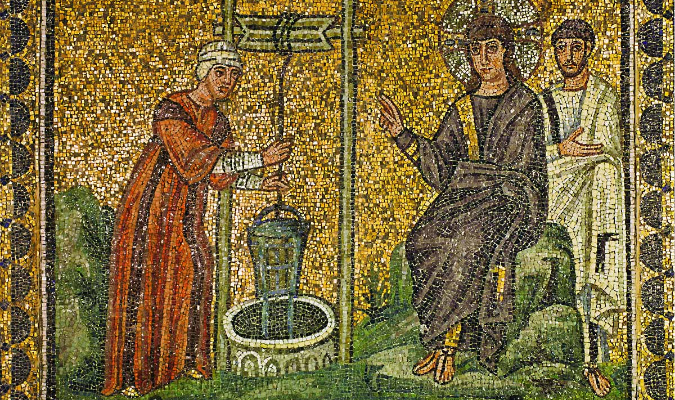
In her sermon (which can be heard here until late April), Carla had a line that cast a fresh light on one of my favorite Bible passages, the woman at the well in John 4. Noting that the woman is gathering water at an unusual time of day, Carla suggested, as most commentators do, that she had been shunned by her neighbors who come in the morning. But then she asked, "Or is it her own self-doubt?"


I'd never thought of that. Shame is a powerful force for tearing us down, but it isn't always imposed from someone else. It can come from ourselves, too. Was this woman shunned by her community or did she exile herself? What little we know of her ("You've had five husbands" v. 18) means she's been widowed or abandoned five times (women didn't have legal standing to seek divorce then). She's known a lot of heartache. I'd never considered that her heartache could be causing her to isolate herself in shame. Perhaps she tells herself, "You're unlovable. They don't want to be near you. You're such a failure."


We all carry such voices around with us; little shame demons that point to our failures (actual or perceived) and our flaws (real or not). They can be rooted in minor incidents from our childhood that scarred us deeply or from repeated behaviors that we can't seem to stop doing. They can be from things we've done, things done to us, or things we've failed to do. They show up in phrases we repeat in our heads:
  • "I'll never really belong at work/in my family/with my friends/at church because I'm imperfect/stupid/different/flawed." 
  • "I'm just not cool/interesting/funny/attractive and someone's going to figure that out."
  • "If I don't keep my life balanced perfectly, I'm going to disappoint people and they'll stop liking me."
  • "If people really knew what I was like..."
Like the woman at the well, shame can lead us to avoid people, hide part or all of ourselves, or just believe that we're not that good or worthwhile.

All of this is why I love that our order of worship in the Lutheran church always begins with confession and forgiveness. Some people look at confession as a negative thing that creates shame by forcing us to think about how bad we are, but I don't.

For me, confession is confronting the shame that I carry with me and the voices that point out my flaws and then being reminded that they don't define me; that's not who I really am.

Because when I stand at the baptismal font each week during confession and splash in the "living water" that Jesus promised the woman at the well, I'm reminded that I'm a child of God, claimed by God's promise of eternal life. My shame and faults that make me feel worthless don't get the last word because I'm someone worth dying for according to Jesus.

My true identity is found in my baptism. When shame leads me to hide away, to avoid the crowds and come to the well in the middle of the day, I can remember that God's identity for me gives me a second chance. I don't need to fear living life fully or being vulnerable because the things I may feel shamed about (by others or myself) don't have to define me. God can reconcile and redeem the points of shame into empathy, wisdom, and compassion for others.

We don't need to live in shame or hide from the crowds. We don't need to listen to the negative voices tearing us down inside. The voice of Jesus says we're forgiven, loved, and adopted as children of God. That's our true identity.

From the Gray,
Pastor Ari

"Here in my head full of shame, you pick me up and say I look like You." -Jars of Clay, "Sing"

Friday, March 17, 2017

Addressing Mental Health in the Church

A friend shared this article from the Washington Post on facebook a few months ago and I've found myself thinking a lot about it ever since. In the essay, Charlotte Donlon writes about living with bipolar disorder, her faith, and her frustration that the church rarely addresses mental illness in meaningful ways, if at all. For me the essay cuts me in a couple different ways.

First, as a pastor, I read how the author's pastor dismisses her mental anguish in conversation and unintentionally shames her in a sermon and I cringe. I cringe because on days where I feel like less than a superhero, that's what I worry I'm doing. I am in near constant fear that I will say something that shames or hurts someone without me meaning to or that I just won't have the right words to say to help. I've learned in my ministry that there are many times where the only true answer is "I don't know." But when someone comes to me with a difficult question looking for some kind of help or hope, it rarely feels like that level of theological honesty is the right answer. Chronic illness, serious childhood diseases, and sudden deaths are all things that make me want to scream "Why God?" with everyone else.

At the same time, I resonate strongly with Donlon's essay because it's my own story, too. I've lived with depression for my entire adult life and shortly before I first read this essay, I was also diagnosed with a generalized anxiety disorder. I have more family members and friends that live with mental health issues than I can count on one hand and I know they are not uncommon in the faith communities that I've served. And yet, there is still a stigma around mental health.

Many churches do awesome work around feeding programs, addiction recovery, poverty assistance, and even healthcare, but it's interesting to me how almost all those programs are directed externally. Meanwhile, internally, few churches in my experience foster an environment that normalizes things like mental health, divorce, addiction, autism, and other issues that are, in fact, normal for most people. Instead, many of us put on masks and pretend to be what we think is "normal" and think we're the only ones faking it.

I don't have any answers for fixing this, certainly not on a grand scale, but I am a big fan of Brené Brown's work that says risking vulnerability and honesty is the root of joy and wholeheartedness and I know Jesus said "the truth will set you free" (John 8:32). So I hope that being vulnerable and honest about my own struggles with mental health might start to normalize it for others.

So...

I have anxiety and depression. I'm medicated for it now and it's helped me a lot. Most of the time I'm fine, but like arthritis or diabetes, it can flare up at times and I can't function at 100% when it does. I'm not ashamed about living with anxiety and depression. In fact, sometimes I think of them as my super powers because I know they are closely connected to my drive to be my best and my creativity.

And I know I'm not alone. And if you're like me, then neither are you.

I pray this is something we can talk about more and I pray that the gift of God's grace gives us the confidence to make being normal... well...
normal.

From the Gray,
Pastor Ari

P.S. If you struggle with depression or think about hurting yourself, please get some professional help. If you can't, have a friend help you. Take it from me: things can get better.


“There’s one more thing I want to say: Our brains are sick, but that’s okay.” -twenty one pilots, “Fake You Out”


Friday, November 6, 2015

What is Normal Anyway?

This morning my church hosted a network meeting of Cross+Generational ministry workers in our area. In the course of our conversation, we discussed mental illness and the difficulty many people have talking about their own or a loved one's mental illness, even though it isn't nearly as unusual as people think.

We stigmatize many issues like mental illness as not being "normal" and therefore feel uncomfortable talking about them, but perhaps the problem is our idea of "normal."

Statistically, it is more likely than not that you or someone you love has experienced mental illness, addiction, miscarriage or fertility issues, incarceration, sexual assault, or abuse. By definition, then, it isn't the person who has never dealt with any of these issues that is "normal," it's all the rest of us who have. And if that's the case then why do we so often treat all these topics as taboo or strange? Especially in church?

As I think about this further, isn't it in the Bible and Christian theology that it's normal to be broken and imperfect? That we experience troubles?

Jesus said he came not for the healthy but the sick (Mark 2:17), and he meant the sin-sick, the heartsick, the sick and tired of life, and sick to death of hiding my troubles.

If that's true, then church is where we bring our struggles and hurt to break down stigmas and taboos, not where we hide them. Then church really is for normal people, but normal doesn't mean what we thought it means.

From the Gray,
Pastor Ari


“We made an art out of neglecting what we don’t want to see.” -Jars of Clay, “Skin and Bones”


Thursday, March 26, 2015

How Psalm 139 Answers Our Deepest Fear

I was at a conference this week for some continuing education and the devotion one morning was based on Psalm 139. Psalm 139 is a well known and beloved poem that speaks of the depth of God's knowledge of us (You have searched me and know me. You knit me together in my mother's womb.) and the impossibility of escaping God (Where can I flee from your presence?).

The presenter asked us a reflection question about what these verses mean to us, but I couldn't help thinking about a different question: Why do people love this Psalm so much? Why do I? There seems to be something universally appealing about this passage and after a minute or so of not paying attention to what was actually going on, I thought, "It's about being known."

I think being understood by another person is one of our deepest held needs and conversely, not being known is one of our deepest fears. We are social creatures at heart and thrive on having at least one person who knows our dreams, gets our humor, loves our quirks, and can even see us at our worst and wants to stay with us until we're better. To be known is to be loved.

And yet many of us can feel lonely or isolated when we feel like we're misunderstood or insignificant compared to others or the vast flood of information in our daily lives. Why should anyone care about me?

Psalm 139 puts into the light one of our deepest fears and offers an answer because it speaks of an intimate relationship with God. It says that God knows us better than any person every could because we cannot escape or hide from God's sight. And yet, this God still wants to be close to us.  We are not unknown, unseen, or forgotten because God created us and knows us completely.


Thursday, February 5, 2015

Grantchester: What a Fake Priest Reveals About Being Real Christians

A fictional character who seems real has me thinking about how much we play characters in our real life.

I recently started watching the PBS series Grantchester. I have a weakness for British dramas and mysteries and Grantchester is both. But what drew me to the show was a description I read that went something like "Sidney Chambers is a priest who loves God, jazz music, a good pub, and solving murder." When I read the description to my wife, she said, "It sounds like you, except for the solving murder part." (My half-joking response: "Maybe one day...")

What my wife said, however, was exactly what drew me to the show. "It sounds like you..." I've mentioned before in my blog my frustration with Hollywood typically portraying clergy as dangerous fanatics or clueless goodie-goodies. (And always men! Dear Hollywood: Women can be clergy, too!) But Grantchester was describing a priest that talks and acts like a real person. Here is a priest that actually sounds like me and most of the pastors I know.

Sidney Chambers goes to pubs, parties, and picnics. He does manual labor, has conversations where he is both compassionate and uncertain, has a complicated love life, and struggles with writing his sermons. In one conversation in episode three, he shares with a priest in training that "this job is difficult" because "most things aren't black and white; a lot of life is gray areas." While it's not a perfect show or a perfect reflection of my experiences as a pastor, it is the closest portrayal of a real life clergyperson I can think of seeing on screen. They are at least striving for authenticity.

That issue of authenticity in a fictional priest has got me thinking about authenticity in my real life job because as much as I dislike the stereotypes of pastors on tv, I know many stereotypes have some small grain of truth in them. Perhaps pastors are portrayed as defenders of spiritual certainty and moral purity because that's how we treat our jobs.

I know I often feel pressure (From myself? Culture? The Church?) to have a simple, clear answer to any situation and I can be afraid of appearing like I don't know for sure. After all, I'm supposed to be the authority on God, right? If I don't have faith all figured out, does that make me an imposter or a failure?

Despite my fears, however, I've often found that the richest and deepest conversations I've had with people have often been from sermons or Bible studies where I've risked saying, "This is hard for me to understand. I wrestle with making this fit my own life." (The most read blog article I've ever written was one where I shared my discomfort with the story of God asking Abraham to sacrifice his son.) In other words, when I've been more authentic myself, it's given permission to others to be more authentic in their faith.

And that permission giving is important because I think all of us have something in our lives where we fear authenticity. It may be related to our social group, our faith, our parenting, or our job, but I'm guessing there's at least one spot in our lives where we're afraid to do or say anything that might show we "don't know" or "don't fit in." Instead, we play stereotyped versions of ourselves, hoping we won't reveal we are imposters.

As Christians, though, we are called to be about the truth. Jesus says, "Let your 'yes' be 'yes' and your 'no' be 'no'" (Matt. 5:37) and promises "the truth will set you free" (John 8:32). God's truth doesn't set us free so we can become stereotypes, but so we can grow in the image of God. And growth is much stronger when we are able to admit the places where we need help and make ourselves vulnerable enough to create relationships that can grow with us.

I am a pastor that loves God, music, a good pub, and solving murder mysteries (on tv, at least). I don't have a perfect answer for every faith question or Bible story, but I pray that being my authentic self and inviting others to do the same will create a community where God's truth is revealed to us all.

From the Gray,
Pastor Ari

(As a side note, I don't think authenticity is the same as "letting it all hang out." I've heard of pastors swearing in the pulpit or oversharing personal details to the point of making people uncomfortable. The authenticity I'm thinking about isn't self-serving ["Here I am! Deal with it!"]; instead it creates a space where you and I can be imperfect together.)


“I stole my personality from an anonymous source.” -Hockey, “Song Away”


Thursday, June 26, 2014

I Don't Like Genesis 22

I've been dreading this coming Sunday for over a month.

You see, this coming Sunday, the lectionary my church uses has appointed Genesis 22:1-14 as the Old Testament reading. And Genesis 22 is one of my least favorite parts of the Bible: the (near) sacrifice of Isaac.

This is the type of text that I usually preach on because there are elements to it that I just can't let pass without some kind of commentary. But the elements that make this passage so difficult also make it hard for me to shape into a decent sermon*. So after much thought I decided to wrestle with it here instead.

For those who are not familiar with the story, God chooses to "test" Abraham by asking him to sacrifice his only remaining son, Isaac, who was a miracle child and meant to start a great "nation" of people. (Abraham's semi-legitimate son, Ishmael, was already sent off in another troubling episode.) Abraham obeys and gets so far as placing his bound child on the altar and raising the knife to slay him when God steps in and stops him.

I'm bothered by the text because of the connections it holds with two problems that are sadly still relevant today: child abuse and violence in the name of God.  When we continue to see children abused and exploited and when suicide bombings, apartheid, and KKK lynchings backed by religious beliefs are current or in recent memory, it's troubling to read a story of God promoting this type of behavior and a person of God who is willing to do both -- and is commended for it.

There are many explanations of this text that seek to ease some of the tension in it:
  • God had invested a lot in Abraham in making him the father of promise and needed to know that he would be faithful regardless of the task.
  • Abraham's Schwarzenegger-esque words to his servant--"We'll be back"--suggest he expected that God wouldn't actually make him sacrifice Isaac and both would return.
  • God was using this episode to condemn child sacrifice (which was practiced by many of Israel's neighboring religions) and show Abraham how his God was different from other gods.
  • Isaac was likely a teenager and Abraham was over 100 years old and couldn't have over-powered Isaac. Therefore, Isaac wasn't a victim, but a willing participant. (In fact many early church leaders used this story as a foretelling of Christ, who also willingly carried the wood to be used for his execution up a hill expecting to lose his life.)
But none of those explanations answer the biggest problem I have with the story: Why did God feel the need to test Abraham? Was God feeling cranky? Was it morbid curiosity? Shouldn't God have already known whether Abraham was faithful? (Abraham had already left his family and home and moved hundreds of miles at God's request.) 

I want to believe that Abraham got the message wrong. I want to believe that between the time the events happened and they were written down, the detail of God testing Abraham was added by the scribes. But I believe that the hard parts of the Bible can't just be brushed off because they're hard or we don't like them. We have to deal with them.

But we don't have to deal with them in a vacuum.

One of the parts of Lutheranism that I love is how we read scripture and one of the key parts of how we do that is the premise that "scripture interprets scripture." Martin Luther, who was often arguing the meaning of scripture with his opponents, knew there were parts of the Bible that didn't seem to agree with each other and so insisted that difficult or confusing texts be read in the context of the whole Bible and especially in the context of the words of Jesus.

In that light, Genesis 22 is easier to swallow. Elsewhere, God clearly condemns child sacrifice (Lev. 18:21; Deut. 18:10), God speaks through Hosea to say "I desire mercy, not sacrifice," and Jesus says "Blessed are the peacemakers" and "Let the little children come to me, for the Kingdom of Heaven belongs to them." Regardless of whether God tested Abraham or why, I look for solace in the fact that in the end, God's true nature won out. God stayed the execution and kept Abraham from killing his son. That is some good news in an otherwise difficult text.

I still feel very uncomfortable with this text, but faith, like life, is rarely simple and God, if the Bible is any indication, is quite complicated. I sincerely pray often to know and understand God better, but Abraham knew God well and that didn't seem to make his life any simpler either. Just one more troubling thing to wrestle with.


“I’m not sure if anybody understands.” -Fun., “Some Nights”


*To me, a sermon is the Living Word of God encountering human reality and creating new life. That sounds kind of vague and fluffy, I'm sure, but what I mean by it is that a sermon is not the same as a lecture. A lecture passes along information; a sermon creates an encounter with God's law and gospel. Every attempt I made with Genesis 22 felt like a lecture.


Thursday, September 5, 2013

Discipleship for Amateurs

I recently started reading Michael Chabon's Manhood for Amateurs, a memoir in essays of Chabon's experiences with being (attempting to be?) a good father, husband, and man without the instruction manual we all desperately want for such complicated pursuits. The essays are at times funny, heart-warming, and heart-breaking, but as the title suggests, one of the common themes in the book is Chabon's sense of being an amateur or imposter, the nagging feeling that he isn't being a man the "right" way. In his opening essay he writes:

"Though I derive a sense of strength and confidence from writing and from my life as a husband and father, those pursuits are notoriously subject to endless setbacks and the steady exposure of shortcoming, weakness, and insufficiency--in particular in the raising of children. A father is a man who fails every day."

As I read the book, one of the thoughts that strikes me (other than, "Wow, I have been there, too!") is whether this is a way that we who claim a religious affiliation live our lives. Do we live with a nagging dread that we don't do faith the "right" way? That there is a specific way to be a faith-full person and if we don't follow it perfectly, we are letting God and our community down? Do we arrive at a place of worship secretly thinking, "I'm such a lousy Christian. Everyone here makes faith look so easy. What's wrong with me?" Do we judge ourselves using ideas that sound ridiculous when spoken out loud like "real men don't cry" or "God won't love me if I wear a t-shirt to church"?

Even though the Lutheran tradition teaches that Jesus is all about setting us free from having to "earn" God's love or be "good enough" to receive eternal life (grace means gift!), I have enough conversations with Christians of all stripes to know that many of us (including me at times) don't really believe that. We obsess over our failures (or what we think they are) to follow God's laws (or what we think they are) and assume we will never get it right. 

It's because of my own secret shame of not being the perfect Christian (I'm a pastor! Shouldn't I be the expert at this!) that I found Pastor Nadia Bolz-Weber's thoughts in a recent sermon very refreshing:

"A couple weeks ago I got to hear Catholic theologian James Allison talk about how we think faith is about striving – keeping parameters, calling people out for not having it right, spiritual practices, doctrinal purity… whatever – but that really faith is about relaxing. Specifically, relaxing in the way we do when we are with a friend who we know for certain is fond of us.  We don’t have to strive around them and we somehow still become our best self – funny, spontaneous, free. Allison suggests that faith is trusting so much that God is fond of us that we just fricken relax."

Relax. This passage brought to mind that maybe as Christians the most important task for us as Christians isn't TO love but to BE loved. And that can be the most difficult thing. I can handle earning love or deserving love, but just being loved, especially when I have a hard time loving myself, is really hard. To think that God can still love me and want me around when I'm not everything God expects me to be (haven't we all disappointed our parents to some degree?) is hard for me to understand, but damn it's good news. And good news is what Jesus claims to be.

“I’ve got blood on these hands that hold on to the truth that I am a priest and a prince in the Kingdom of God.” -Andrew Peterson, “Fool With a Fancy Guitar”