Showing posts with label worship. Show all posts

Friday, October 7, 2022

Let's Stop Fighting About Turkey Sandwiches

Photo by Mae Mu on Unsplash
One of my first jobs was working at a coffee and sandwich shop. Every day, I'd take orders and make sandwiches with a variety of vegetables, condiments, cheeses, and even grill them if asked. There were thousands of possibilities for customizing a sandwich, but all of them included two pieces of bread and some meat. 

And no one ever got into an argument over what someone else ordered on their sandwich.

"Why would anyone get into an argument about what someone else likes on their sandwich," you ask? We shouldn't, but it occurred to me recently that many of the debates and arguments that we get into in churches are like fighting over sandwiches. 

Churches have many ways of doing things. In worship alone, congregations need to decide on:

  • Do we have music? What style? What instruments will lead it?
  • Is there preaching? Who can preach? How long should it be? 
  • Do we read scripture based on themes? Reading a section in order? Following a lectionary (i.e. a predetermined schedule of readings shared by many churches)?
  • Is worship loud and energetic? Quiet and reflective? In the morning? Evening? How long?
  • And more recently for many churches: will people worship in person, online, or both?

We have many denominations and congregations in the United States that have started over questions like these and most people choose a church to attend based on their preferences to questions like these. But they are preferences. They are not requirements or orders from God. 

In the sandwich metaphor, we might say they are like the toppings on a sandwich. Some people like their sandwich to have lots of onions and spicy mustard with two kinds of cheese; others prefer just turkey, mayo, and a slice of cheddar. And that's fine. There's nothing wrong with having different preferences.

Martin Luther and his fellow reformers had a word they used to describe these preferences: "adiaphora." It's a Latin word that basically means, "things that don't really matter" and for their purposes, meant "things that don't impact our salvation." In other words, whether or not you like a certain hymn or piece of architecture doesn't change that your faith in God's grace grants you new life. 

But many congregations have debates that sound like: "The way I make my turkey sandwich is the only way to do it and everyone has to agree with me or they aren't welcome." For example: 

  • "Someone keeps wanting to put whole wheat bread in the sandwich line. No one likes that stuff."
  • "I tried a grilled sandwich once and it was terrible. I hope we never serve that here."
  • "I don't like Swiss cheese. Maybe we should stop offering it so that people learn to stop eating it."
These sound ridiculous, but if we swap out the options with words like "classic hymns," "upbeat music," or "worshipping online," they probably sound like things many churchgoers have heard or said. So, are we fighting over sandwich toppings? 

Again, there's nothing wrong with having different opinions about sandwich toppings, but they are adiaphora. They aren't necessary to have a turkey sandwich. You just need to make sure you have turkey and bread. So what is the turkey and bread?

Luther and the reformers had an answer for that, too. In Article VII of the Augsburg Confession they wrote: "The Church is the congregation of saints, in which the Gospel is rightly taught and the Sacraments are rightly administered." So, church is where people of God hear the Gospel and receive the sacraments. In preaching on Luke 13:10-17 recently, I paraphrased it by saying, "Church is where Jesus shows up and healing happens, physically, spiritually, or otherwise." That's the turkey and bread: Jesus shows up; healing happens.

There are hundreds of ways to make that happen. Most churches come up with one recipe and stick to it. My church tries to swap in different options from time to time because we know we have a variety of preferences in our congregation. Last year, we made the decision to have at least one hybrid service per week for people to attend in person and online together. We're learning to make everyone who attends feel included and welcome. I know there are many things we try or do regularly that not everyone loves, but I always try to have a space where something for your sandwich is awesome, even if you don't like everything on the table. Like a buffet, if you don't like something, just skip it and let someone else eat it up. 

But always -- ALWAYS -- let's make sure we have meat and bread. Welcome to church. Let's eat.


From the Gray,

Pastor Ari

“I’d rather fight you for something I don’t really want than to take what you give that I need.” -Rich Mullins, “Hold Me, Jesus”



Thursday, September 29, 2022

Why No One Should "Go to Church"

Is it church if no one's there?
(Photo by 
JOHN TOWNER on Unsplash)
Years ago I cut out a magazine article and posted it on my office door. It was written by Dan Kimball, an Emergent church pastor from California. As he starts out, he shares a story of telling a group at his church that “According to the Bible...it is actually impossible to ‘go to church.’” After letting confusion wash over their faces, he explains that in the New Testament, the word “church” never applies to a building, but always to the people who follow Jesus. “We can’t go to church,” he concludes, “because we are the church.” (Unfortunately, other than these quotes, I can't find any trace of the original article. 😞)

This is a principle that we’ve all learned (I remember singing in Sunday school, “I am the Church, you are the Church...”), but we don’t act like we have. The way we typically talk about church actually suggests that we think of “church” as the building, or, at least, as only what we do in that building. 

Instead, we need to distinguish between the church that is a static building and the church that is a people or a movement. Being an English major and a writer, I like to think of them as the "little c church" (building) and "big C Church" (the people).

The word the early Church used to describe itself in Greek is “ecclesia,” which literally means “those called out.” The Church, then, is the people who are called by God. We are called out of things and ways of living that rob us of life and joy and God’s presence, called to gather to hear the Good News of life through Christ. And we are also the people called out of our places of worship (out of our comfort zones?) to be the Church in the world and for the world.

This is why Paul says Christians are the "Body of Christ," a living, moving extension of God, instead of an unmoving building. (Or maybe an unmoving audience?) If we think church is just the building, we can think our faith and lives are as static and passive as the building. It becomes the country club (or bomb shelter) that we retreat to when we need to rest. 

One of my favorite images for the church I heard years ago at a youth gathering (I apologize that I can't credit the source), where someone said, "We too often think of church as a buffet, where we come to gorge on God and then hope we won't starve before we return; instead, we need to think of church as the grocery store where we gather the ingredients we need to make meals throughout the week."

Just as the goal of going to the grocery store is to have a dinner party, the goal of going to church (the building) is to live as Church (the people). We are "called out" as the Church not to escape from the world or hide from it, but to learn to live in it with identities, patterns, and habits that are healthy and cooked from good ingredients. 

The God of Life has called us out, called us out of death and into life, called us out of the noise and chaos the world around us to rest in (and then share) a message of hope. God calls for us to grow in that life and God calls us to share that life with others. God doesn't want us to go to church; we are called to be the Church.


From the Gray,
Pastor Ari

"May this place of rest in the fold of your journey bind you to hope. You will never walk alone." -Jars of Clay, "The Shelter"


Tuesday, October 23, 2018

What is Appropriate Prayer?

For the past month, Milwaukee has been buzzing. Our local Major League team, the Brewers, was on a tear. They finished with the best record in the National League, made the playoffs for the first time in seven years, and won twelve in a row to win the NL Central title and sweep the first round of the playoffs. It has seemed like everyone was wearing Brewers gear and talking baseball in our area.

On Saturday, the Brewers hosted game 7 of the NL Championship against the LA Dodgers with a chance to go to the World Series for the first time since 1982 and the city was electric.

But they lost. No World Series. No more season. There was no joy in Mudville, for mighty Casey had struck out...

The next morning, during the late worship service at my church, the assisting minister added an impromptu petition to the prayers that was something like: "Lord, help us in our grief over our baseball team losing. We wanted to go to the World Series and it hurts. Help us get over it and look forward to next season."

In the moment, I didn't know exactly what to think about the prayer. I wondered if some would be offended by including something like a sports team in the prayers. Would some feel it wasn't appropriate for the prayers in church? Did I?

As I continued to think about it, I remembered that I myself often tell people there is no bad prayer. "Prayer," I say, "is just speaking honestly with God." I sometimes use the examples of Psalm 137 or Psalm 109, where the writers pray for God to bring suffering to their enemies. I also use them as examples of the truth that God is with us in times of pain and suffering. If those bitter songs are saved as examples of prayer in the Bible, we can be honest with our own pain, anger, or whatever we feel.

As I thought about it, I realized this prayer was speaking honestly with God. She was saying, "Sure, it's just a baseball team, but a lot of us here are hurting today. If you're with us in any suffering, please be with us in this time of pain." In a different situation, it might have been silly or frivolous, but on that morning, it was true and sincere. That, I believe is God's hope for our prayers, because when we are honest about ourselves, we can be more open to what God has to say to us.

May we all be reminded that there is no part of our lives that is beyond God and nothing that God doesn't want to hear from us. 

From the Gray,

Pastor Ari


“I’m-a say all the words inside my head.” -Imagine Dragons, “Believer”


Thursday, May 17, 2018

Flour Power

At my church, children who don't take communion yet get a blessing when they come to the table with their family. Usually I rest my hand on their head as I bless them and trace a cross on their forehead to remind them of their baptism.

As I do, there is often an unintended side effect.

That's because we also use homemade bread for communion at my church (yum!) and it has flour on it from the kneading process. So when I bless the children, they end up with a dusting of flour that my hand has picked up from the bread. They leave the table with a visible residue of God's blessing for them in their hair.

It helps me to remember that what we hold on to will leave a mark on things we touch. What am I holding on to and what kind of residue am I leaving behind me? Are my hands dirty with grime or with grace?

I hope and pray that my words and actions dust the world with blessings and I hope yours do, too.

From the Gray,
Pastor Ari


“I want the markings made on my skin to mean something to me again.” -twenty one pilots, “Doubt”


Thursday, April 5, 2018

Where To Start...

On Maundy Thursday (the Thursday before Easter), the worship service in my tradition begins with the sermon. In explaining this change, the worship reference book* says, "The relocation of the sermon enables the preacher to deal with the various aspects of the theme of Jesus' love as a background for the entire service." In other words, we start with Jesus' love because everything in this worship is about Jesus' love.

As I read that this year, it gave me two thoughts.

First, that is a good summary for Lutheran theology. Jesus' love is the background for everything. Because salvation/eternal life/reconciliation is a gift from God, God's love and grace is the beginning of and background to everything we believe and do. Nothing begins without God's love.

That led to my second thought: what if I tried to live with that thought always in mind?

  • My day begins because of Jesus' love. 
  • I will begin this email with Jesus' love. 
  • Jesus' love will be in the background of this difficult conversation. 
  • How is Jesus' love in the background of this meeting? Of this meal with loved ones?
  • I will write this blog with Jesus' love...
This week I'm playing around with what that looks like for me. How about you? How would treating Jesus' love as the beginning and background to all you do change how you speak, think, and act (or react)? 

From the Gray,
Pastor Ari


"Let's start at the very beginning, a very good place to start." -The Sound of Music, "Do Re Mi"


*(Lutheran Book of Worship: Ministers Desk Edition for anyone who cares.)

Saturday, March 25, 2017

Shame, Confession, and True Identity

This past Sunday, I was privileged to have a member of my church's preaching team provide the sermon. I love getting to hear others preach because it helps me hear other facets of the text and fresh perspectives that help me shape my future sermons.

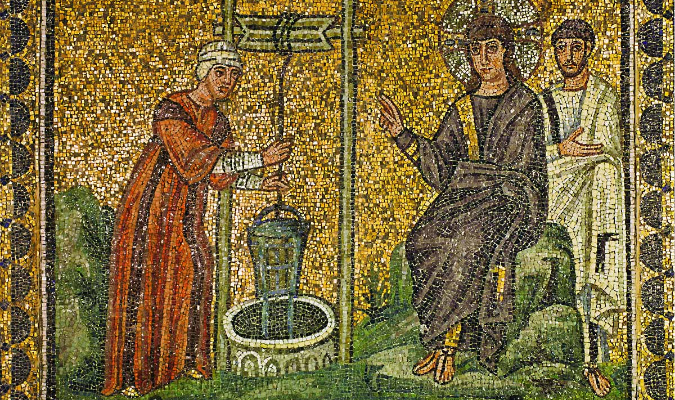
In her sermon (which can be heard here until late April), Carla had a line that cast a fresh light on one of my favorite Bible passages, the woman at the well in John 4. Noting that the woman is gathering water at an unusual time of day, Carla suggested, as most commentators do, that she had been shunned by her neighbors who come in the morning. But then she asked, "Or is it her own self-doubt?"


I'd never thought of that. Shame is a powerful force for tearing us down, but it isn't always imposed from someone else. It can come from ourselves, too. Was this woman shunned by her community or did she exile herself? What little we know of her ("You've had five husbands" v. 18) means she's been widowed or abandoned five times (women didn't have legal standing to seek divorce then). She's known a lot of heartache. I'd never considered that her heartache could be causing her to isolate herself in shame. Perhaps she tells herself, "You're unlovable. They don't want to be near you. You're such a failure."


We all carry such voices around with us; little shame demons that point to our failures (actual or perceived) and our flaws (real or not). They can be rooted in minor incidents from our childhood that scarred us deeply or from repeated behaviors that we can't seem to stop doing. They can be from things we've done, things done to us, or things we've failed to do. They show up in phrases we repeat in our heads:
  • "I'll never really belong at work/in my family/with my friends/at church because I'm imperfect/stupid/different/flawed." 
  • "I'm just not cool/interesting/funny/attractive and someone's going to figure that out."
  • "If I don't keep my life balanced perfectly, I'm going to disappoint people and they'll stop liking me."
  • "If people really knew what I was like..."
Like the woman at the well, shame can lead us to avoid people, hide part or all of ourselves, or just believe that we're not that good or worthwhile.

All of this is why I love that our order of worship in the Lutheran church always begins with confession and forgiveness. Some people look at confession as a negative thing that creates shame by forcing us to think about how bad we are, but I don't.

For me, confession is confronting the shame that I carry with me and the voices that point out my flaws and then being reminded that they don't define me; that's not who I really am.

Because when I stand at the baptismal font each week during confession and splash in the "living water" that Jesus promised the woman at the well, I'm reminded that I'm a child of God, claimed by God's promise of eternal life. My shame and faults that make me feel worthless don't get the last word because I'm someone worth dying for according to Jesus.

My true identity is found in my baptism. When shame leads me to hide away, to avoid the crowds and come to the well in the middle of the day, I can remember that God's identity for me gives me a second chance. I don't need to fear living life fully or being vulnerable because the things I may feel shamed about (by others or myself) don't have to define me. God can reconcile and redeem the points of shame into empathy, wisdom, and compassion for others.

We don't need to live in shame or hide from the crowds. We don't need to listen to the negative voices tearing us down inside. The voice of Jesus says we're forgiven, loved, and adopted as children of God. That's our true identity.

From the Gray,
Pastor Ari

"Here in my head full of shame, you pick me up and say I look like You." -Jars of Clay, "Sing"

Friday, September 16, 2016

Setting the Table of God

This past Sunday, through one of those situations that happens from time to time, my congregation found ourselves without our usual communion bread for worship. We have a wonderful team of volunteers who make homemade bread for us every week, but last week, none showed up. Thankfully, we keep a box of wafers around just in case and we pulled them out for the holy meal this day.

For anyone who isn't familiar with communion wafers, they are thin, tasteless discs about an inch in diameter that are engineered to dissolve quickly on the tongue and have a shelf life of about one hundred years. I jokingly refer to them as "crispy Christs," but for many people who grew up in the church in the twentieth century, these wafers were the norm for years.

For kids at Martin Luther Church, though, they are not.

This fact became clear during communion. Several appeared puzzled. One young person audibly said, "ugh" when I handed him the body of Christ. Another looked at it with a confused expression and then handed it to his mother.

At the time, I chuckled to myself over their honest reactions. As I thought about it later, though, I realized there was more than a "kids will be kids" truth to their reaction. They came expecting good food at communion -- and why shouldn't they? If "this is the Lord's table" (which I say every week), and our Lord is generous and loving, why shouldn't we expect good food at God's table? If the Lord's Supper is meant to be a "foretaste of the feast to come," I think fresh bread and a decent cabernet is a better representation of that feast than stale wafers and Manischewitz.

Going beyond the quality of communion, I think the same could be said about other aspects of church as well. Do we participate half-heartedly in worship? Do we allow clutter and disfunction to persist in our church? Do we serve weak coffee and stale cookies? (Seriously, why can't more churches make a decent cup of coffee?) Or do we offer our best as a community to both regulars and guests as a reflection of the great gift we've received in Christ?

Now, giving our best isn't the same as being perfect, but I believe we should act as though what we are doing matters to us and furthermore, we want it to matter to those around us, too. How do we set the table of our church on Sunday and our lives during the week so that people come to expect the best of God when they gather there?

From the Gray,

Pastor Ari


“I know you’re supposed to be my steering wheel, not just my spare tire.” -Arrested Development, “Tennessee”

Thursday, July 28, 2016

What I Learned at the Grand Canyon

Last month, I found myself standing on the rim of the Grand Canyon for the first time in my life. And it taught me something about Christian stewardship.

For vacation this year, my family took an epic road trip through the Southwest that included this amazing natural wonder. It's hard to overstate the enormity of the canyon. I frequently felt as though my eyes were playing tricks on me because my brain couldn't process the scale of what was in front of me.

On my last day there, I stood looking at the canyon and reflecting on the history of turning this area into a national park. As I looked at the billions of years of history laid out in front of me, it struck me that the very idea of anyone "owning" something like this was comical. It's been at work for so much longer than any one human life (or even all human life) that to think it can be controlled is silly. All we can do is to appreciate it, protect it for the sake of all people, and pass it along to the next generation.

It was in that moment that I found a new appreciation for the Christian concept of stewardship.

Stewardship is a common word in churches, and it often gets used to mean "give money so we can pay the bills." This is not what we are meant to think, however.

Classically, the "steward" was a servant tasked with overseeing the house of a master. The steward didn't own the house or goods, but was responsible for caring for and preserving the house and goods. For Christians, we start from the assumption that "the earth is the Lord's and all that is in it" (Psalm 24:1). Everything we own, even our talents, passions, and opportunities, are all from God. We don't own them, but are tasked with caring for and using them in ways that align with the Master's vision.

It can be easy to be distracted by thinking about what we own, what we want, or what we "deserve." We can be motivated, stressed, or obsessed by these thoughts. But as I looked out at the Grand Canyon, I was aware of how small I am in the great scheme of the world. Compared to the history of God and the earth, the thought of "owning" my home, my salary, and my talents seems just as laughable as owning the Grand Canyon. I've been entrusted these things for a while, but they will pass to others at some point. Will I hoard them temporarily or steward them on behalf of their true owner? Like the Grand Canyon, all I can really do is appreciate it, steward it for the sake of all people, and pass it along to the next generation.

From the Gray,

Pastor Ari


“In a world where what we want is only what we want until it’s ours.” -Train, “Calling All Angels”


Thursday, November 19, 2015

A Song to Change the World

(This first appeared as a column in my church's newsletter.)

“And Mary said, ‘My soul magnifies the Lord, and my spirit rejoices in God my Savior, 
for he has looked with favor on the lowliness of his servant.” Luke 1:46-47

In Luke’s Gospel, we are treated to one of the most beautiful moments of the Bible. As Mary visits her cousin Elizabeth to share the news of her pregnancy, she bursts into song with a glorious hymn that is known as the Magnificat. 

“The Mighty One has done great things for me, and holy is God’s name.”

It is a wonderful and beloved song that has been adapted in countless songs and prayers over the years. (My personal favorite is a toss up between the version in “Holden Evening Prayer” and “The Canticle of the Turning.”) Like many familiar texts, however, it is so well known that we can sometimes forget the radical nature of its words.

“God has scattered the proud in the thoughts of their hearts.”

Mary sings in the song of God turning the world upside down, suggesting that the birth of Jesus is the start of a new order. In this new order, those with wealth and power are “cast down” and the poor, hungry, and weak are cared for by God.

“God has brought down the powerful from their thrones, and lifted up the lowly…”

In the stories we retell every year, we can see the way that Jesus began upsetting the status quo from the very beginning. Lowly shepherds are the first to hear the good news of his birth, wealthy astrologers from afar show up in a backwater town to bring gifts to this new child, and King Herod sends his army after him because he knows this child spells doom for his tyranny. As his ministry continued, Jesus continued to turn things upside down, comforting the sick and outcast and arguing with religious leaders and the powerful. Finally, he even turns death inside out on Easter weekend.

“He has helped his servant Israel, in remembrance of his mercy…”

For Advent this year, my church going to spend time considering this important and beautiful song that foretells Jesus’ meaning for the world. Under the theme of “Inside Out,” we’re going to look at the ways Jesus turns inside out how we view God, how we live, and even our very hearts. How do these words challenge our assumptions about ourselves and the world and push us out of our comfort zones? We will sing this song and listen for how it speaks of hope for today as well.

“Surely, from now on all generations will call me blessed.”

In this busy season of shopping and planning and parties, it may be good to hear a song that reminds us what God’s love means. In a world where there is so much crazy, trouble, and heartbreak, maybe things need to be turned inside out and upside down. 

“…according to the promise God made to our ancestors, to Abraham and to his descendants forever.”

In God’s Amazing Grace,

Pastor Ari

"Wipe away all tears for the dawn draws near and the world is about to turn." -"Canticle of the Turning" (Hymn adaptation of the Magnifcat by Rory Cooney)

Sunday, March 1, 2015

Lent, Easter, and Pentecost: Going Up, In, and Out

(This post first appeared in my church's newsletter in Spring 2015.)

A few years ago, I was at a conference where the speaker summarized the practices of a church congregation in three simple words: Up, In, and Out. Everything a congregation does, wants to do, and believes about itself fall into these basic categories, he said. Most churches will specialize in one or two, but all three are important to be a healthy church.

Up refers to individuals’ relationship with God and includes things like devotionals, Bible study, and prayer groups.
In refers to individuals’ relationships to each other and includes fellowship activities and community growth.
Out refers to a congregation’s relationship to the community and world and includes service projects, evangelism, and other outreach.

Ever since, I’ve found this to be a helpful tool to evaluate a variety of things: Do our upcoming programs include enough “up” opportunities? Have my sermons recently been focused more heavily in one area than the others? Is my own faith life leaning away from service or prayer or relationships? 

Up, In, and Out is a short and easy way to think about a lot of things related to being the church. As I sat down to write my newsletter article for the spring, it occurred to me they are also a good overlay for the coming seasons of the church year: Lent, Easter, and Pentecost. 

Lent, with its focus on spiritual discipline and “returning to God,” is a time of Up. In Easter, we read the stories of the early church and how they came together, learned how to be a new religious community, and grew; that’s In. Pentecost tells us the story of the Holy Spirit kicking open the doors and driving the church Out into the world to serve, greet, and love those who were not yet part of the church. 

Just as Up, In, and Out are all needed for a healthy church, all three are needed for a healthy personal faith, too. With that in mind, you may want to consider using these coming seasons as a chance to focus on these three areas in your own life. During Lent, if you don’t already, pick up a discipline, find a good devotional, carve out time to pray, or read a book in the Bible. In Easter, you could seek out a Cross+Generational event, attend a Bible study, or pledge to come to worship more often than you normally would. In Pentecost, volunteer at Tosa Cares or Serenity Inns, bring an item weekly for one of our collections, or just spend time walking your neighborhood and getting to know your own neighbors. 

Whatever you may choose to do, remember that Jesus has “gone ahead of you” so “you will see him” (Mark 16:7). Up, in, or out, God is present in every direction. As always, please share what you learn and experience with me or another sister or brother.

In God’s Amazing Grace,

Pastor Ari


“The whole universe is witness to only a part of what you’ve done.” -Downhere, “Let Me Rediscover You”


Thursday, December 4, 2014

These 7 Things Give Me Hope

This year during Advent, my worship planning team came up with the idea of giving gifts each week, or more accurately, naming some of the gifts God gives to us. Each week we are sending worshippers home with "gift tags" like these pictured that name a gift we get from God and then have a question or activity to connect the gift with life during the week.

This week, in response to Jesus' message "Heaven and earth may pass away, but my words will not pass away" (Mark 13:31), we made this past Sunday about "Hope." The tags we sent home said, "Each day, name one thing that gives you hope about the future." As I've considered this challenge this week, I thought I'd share my list here to encourage and hopefully spread the conversation beyond my congregation.

So here are my seven things that give me hope for the future:
  1. My Kids - I'm biased, I know, but my kids are kind, loving, creative, whip-smart, and generous.* (My daughter recently took some of her allowance to school and gave it to one of her teachers whose smart board had died the day before. The teacher returned the money with a very touching thank you card.) If my kids keep these traits, I have no fear about their own future and if there's a handful more like them in the world, the rest of us will be okay, too. (*Most of the time.)
  2. Modern Medicine - One hundred fifty years ago, we didn't know about germs and we've since destroyed small pox and vaccinated many other diseases into an afterthought. Ebola is doing awful things in Africa now, but twenty years ago we thought AIDS might end humanity and it is now manageable. Just in the time I've been a pastor, I've seen surgeries that used to hospitalize people for days or weeks turn into out-patient surgery. (I once missed visiting someone following a hip replacement because they were released within 48 hours!) Cures and treatments that were once miraculous are now commonplace and more miracles are becoming common every year.
  3. The Fact That My Elders Were Just As Uncertain About The World Their Kids Would Inherit - I recently had a conversation with a mother who confessed she had been uncertain about ever having kids because "I didn't want my kids growing up in a world like this." "But," she said, "My mother and grandmother told me they thought the same thing in their youth." I've thought this same thing, but the world has never turned out quite as bad as the previous generation has thought and has largely thrived in the past century. If their pessimism was wrong, mine probably is, too.
  4. Music - Most people who know me know that I love music. I usually have it playing in the background while I work or clean and my idea of a self-indulgent evening is to sit down with a set of headphones and listen to a favorite album from beginning to end with my eyes closed. Music gives me hope because at its best, I find it to be a transcendent experience that opens my mind and heart to visions of the world as it should be. A great song can transport me to an emotional plain that inspires and energizes me to make myself and the world around me a better place. 
  5. Surprise - I am regularly surprised in my life. I'm surprised by compliments from unexpected sources, by unsolicited help, by small and even anonymous acts of kindness, by people who share hidden passions and interests, by children that blurt out simple but powerful statements of love and truth. It gives me the sense that there is much more goodness and kindness in the world around me than is known or seen. I tend to focus on tragedies and troubles (thank you, media), but there is a great deal of uncelebrated kindness happening, too.
  6. My Spouse - She's my biggest cheerleader and best support. I'm amazed and inspired by her. To crib from Jack Nicholson in "As Good As It Gets," she makes me want to be a better person. Any future with her is worth looking forward to.
  7. My Baptism - Martin Luther once said that when the dark voices start whispering how worthless, hopeless, or sinful you are, a Christian should cry back, "But I am baptized!" As a Christian, when I feel hopeless about myself or the future, knowing that I've had God's promises poured over me -- promises that can't break, tarnish, or expire -- is a great source of hope for me.
I'd love to hear your own thoughts on where you find hope in the comments (or in person). Thanks for taking the time to read mine and may your holiday season be filled with hope. 

In the Gray,
Pastor Ari

“Author of the moment, can you tell me: do I end up happy?” -He Is We, “Happily Ever After”


Friday, June 6, 2014

Which Came First: The Reason or the Change?


One of the blogs I subscribe to is by Seth Godin. Godin writes daily on the emerging information and internet economy and I love to read his posts because he is concise and I can read most of them in under a minute (a skill I wish I had for my own writings). More importantly, he has a unique perspective on the modern world that often gets my own creative juices going for myself and my job. 

This morning's post was a prime example. The last line stopped my coffee mug half way to my mouth: It turns out, humans don't use explanations to make change happen. They change, and then try to explain it.

Though Godin certainly didn't intend it in the context of church, his quote immediately brought up all kinds of thoughts about Christian education, evangelism, and church culture. I think this quote captures part of what has been wrong with Christianity's approach to presenting itself for the past five hundred years or so. Starting with the Reformation and increasing through the Enlightenment, the Great Awakenings, and into the recent past, it seems that the Church (at least Western Protestantism), has come to believe that the key to evangelism is making a rational defense of faith. If I can make a logical proof of God/Jesus/faith, then people will come flocking to church. Many writings, sermons, and Sunday school lessons are built around that basic idea.

If Godin is correct, that kind of thinking is largely false. A logical argument may get the ball rolling in someone's mind or reinforce a change that was already underway, but it rarely is the whole of a person's life changing. 

I've attended church my whole life and when I think back, I realize that it wasn't the lessons I learned in Sunday school that "convinced" me about God as much as it was love my teachers had for me; it wasn't the logic in the sermons as much as the songs and rituals of worship echoing in my ears and heart. It was moments of supreme fellowship, beauty, truth/insight, and wonder that opened me up, turned me around, or overwhelmed my heart in ways that I didn't have language for in the moment. It was afterwards that I was able to use the vocabulary I had learned in Sunday school or Bible study to explain the change. I didn't get explained into a relationship with God, I found myself in relationship with God and then explained it.

A helpful contrast to the "Western" emphasis on explaining and logic can be found in the Orthodox church. An Orthodox worship service, with its elaborate rituals and traditions, is meant to give participants an experience of heaven, inviting people into the activities of God and being changed through the process. I'm a liturgy geek, so I know I'm biased, but I find a worship service that gives me an experience of God to be much meatier than one that just tells me about God. To be fair, Classic Catholic and Protestant worship was built around similar intentions to an Orthodox service, but the centrality of the sermon in most people's minds today demonstrates the shift that has happened culturally. (My tribe of Christians, Lutherans, also tends to be suspicious of anything that sounds too "emotional" because of some theological battles we had almost 400 years ago.)

Humans don't use explanations to make change happen. They change, and then try to explain it. If Godin is right, then the church doesn't need a perfect argument to "prove" God to the world. Instead, the church is a place where we promote and practice change (personal, social, mental, spiritual) and then help people find the language to explain it when it happens.


“Change this something normal into something beautiful.” -Jars of Clay, “Something Beautiful”

Thursday, March 6, 2014

The Weight of Ashes and the Unbearable Lightness of Bread

One of the hardest things I do in my job as pastor is Ash Wednesday worship. It's not that it's a complicated service or that it's physically demanding in any way. It's giving the ashes.

In the Christian tradition, ashes are marked on the forehead at the beginning of Lent as a sign of repentance and of our mortality. As I mark the cross on people's foreheads, I speak the words recorded as spoken by God to Adam: "Remember that you are dust and to dust you shall return." They are a reminder that we are mortal, with limited time on this earth. I am basically saying to people: Your life is precious. It's precious because it's short, so don't waste it. Or, if want to be blunt: Someday, you are going to die.

Now, imagine saying that to dozens of people while looking them in the eye.

To the person battling cancer: "You are dust..."

To the recent divorcee: "You are dust..."

To the new parents: "You are dust..."

To a child (including my own): "You are dust..."

Over the years, I've spoken those words to hundreds of people including infants and elderly, newlyweds and widows, poor and wealthy, and some who have indeed returned to the dust before that coming Easter. As I speak those words repeatedly, extending my black-stained thumb to touch the head of someone who will one day be dust, it's inevitable that at some point I start to choke back tears and feel my heart tighten within me with the weight of the moment. Your life is precious. Your life is precious. Your life is precious.

I can often get to the end of Ash Wednesday worship and be exhausted from those few minutes of ashes, but this year was different. Yesterday the ashes were answered in a way I'd never felt before.

Later in the service, we celebrate the Lord's Supper and once again, people come forward from their seats to receive these mysterious elements, a morsel and a sip that somehow contain an infinite mercy. And once again I find myself looking people in the eye and extending my hand to each of them, but this time I speak different words: "This is the Body of Christ, broken for you." And once again these words carry meaning deeper than the literal one because I am saying: Here is Jesus, the Bread of Life, who has come to feed our spiritual hunger. Here are the words -- "for you" -- that ring with good news.

What struck me for the first time this year was that in those words, I was saying the same thing as with the ashes, but in reverse. In sharing the bread I was saying: Your life is precious. It is precious because God decided it was worth the cross, so your life won't go to waste. As I repeated the words and looked at the ashes on people's heads, I felt my heart grow light and the corners of my mouth curl in joy. Your life is precious. Your life is precious. Your life is precious.

One of the things about religion that continues to drive me to explore it is the sense of paradox and mystery, that two contradictory statements can both be true (e.g. Jesus is fully God and Jesus is fully human) and that some statements can mean more than one thing. In between the ashes and the bread last night, I discovered that they carry the same message, but different meanings, and in that message is contained the heart of both Lent and Easter: Your life is precious. 


“...and life is just a dare we take.” -Jars of Clay, “Out of My Hands”